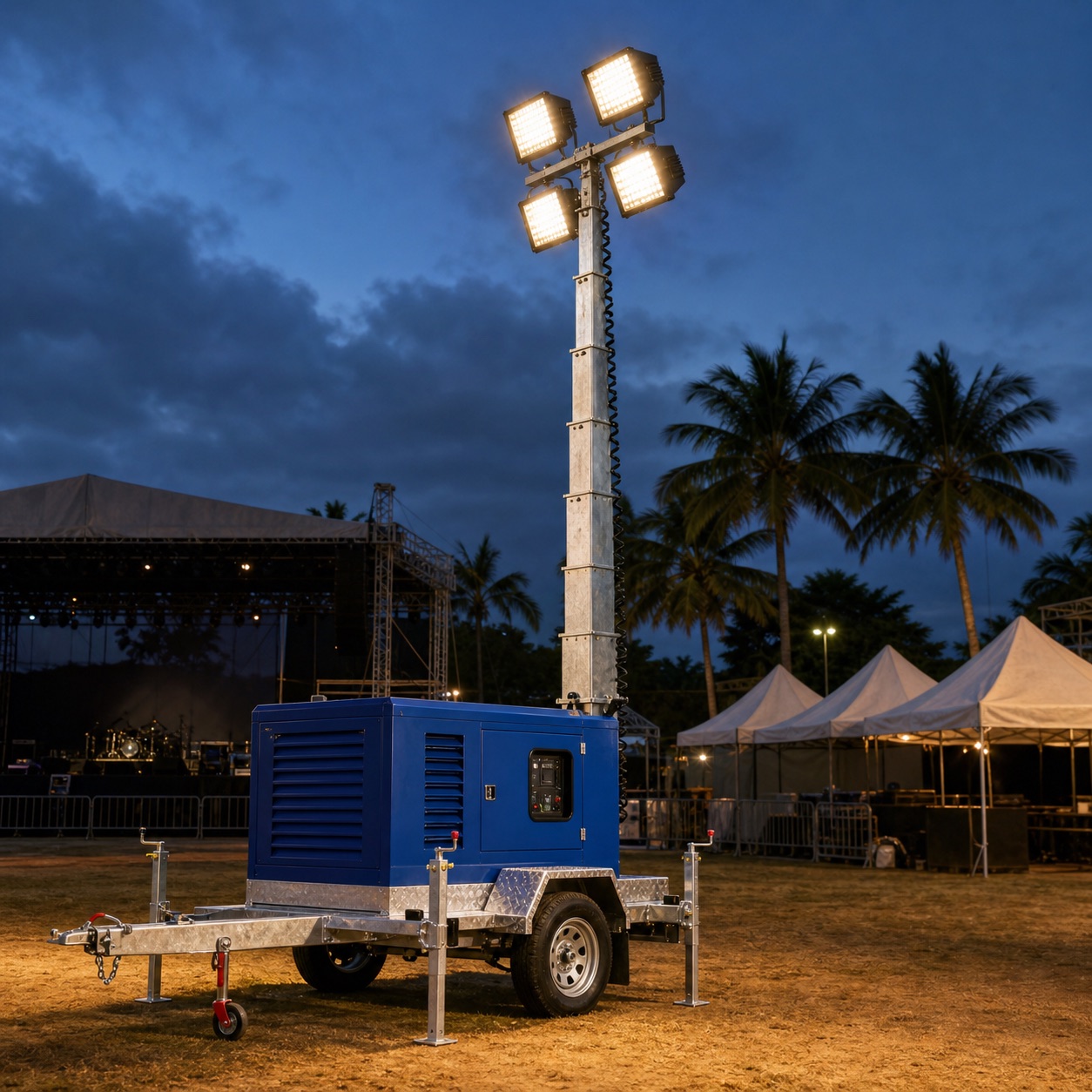
These two get compared as if one is a better version of the other. They are not — they solve opposite problems. A high mast throws light a long way in a direction. A balloon unit throws light nowhere in particular, on purpose. Knowing which problem you have makes the choice obvious.
What a high mast tower light is for
Reach. A taller mast puts the heads above the obstructions, which means light lands past the plant and the material stacks instead of stopping at them.
That makes it the right answer for open ground and long linear works — a carriageway, an earthworks platform, a yard where you need one position to serve a wide area rather than following the work around.
What you pay for that reach
Directionality. Light thrown a long way is light thrown at somebody, and from the wrong angle a high mast is a very effective way to blind a driver or a machine operator.
It is also more sensitive to wind, and it takes more thought to position. Height is a real capability, but it is not free and it is not always what the job needs.
What a balloon light tower is for
The opposite job: filling an area with soft light that casts almost no shadow and produces almost no glare. The diffuser spreads output in every direction rather than aiming it.
That is why it suits events, ceremonies and anywhere the public is walking around — nobody is squinting, nothing has a hard shadow behind it, and the lighting stops being something people notice.
Where balloon units are the wrong call
Anywhere you need distance. Soft omnidirectional light falls off quickly, so a balloon unit lighting a wide open site produces a pleasant glow near the unit and not much further out.
They are also less suited to detail work at a distance from the mast. If people are reading marks or setting formwork twenty metres away, they want direction, not diffusion.
The quick way to decide
Ask what would go wrong first. If the answer is "the far end will be dark", you want mast height. If the answer is "somebody is going to complain about the glare", you want a balloon.
On mixed sites both can be right in different corners — a mast over the works and a balloon over the walkway is a common and sensible combination.
Confined and indoor spaces change the answer again
Both of these assume open ground. Inside a structure — a basement car park, a plant room, a tunnel section — neither a tall mast nor a large balloon is the right tool, and a diesel unit may not be an option at all.
That is where battery-platform lighting earns its place: compact, silent, no exhaust, and small enough to reposition by hand as the work moves through the space.
The mistake to avoid is bringing an outdoor unit indoors because it is what was already on site. If the works are moving under a slab or into a basement, that is a separate lighting decision, not a repositioning of the one you already have.
What to ask for if you are not sure
You do not need to name a unit type. Describe the failure you are trying to avoid and the choice follows from it.
"People will be walking through this" points at diffuse light. "The far end needs to be visible from here" points at mast height. "There is a stage and a speech" points at noise before either. "It is under a slab" changes the answer entirely.
Suppliers who ask you which unit you want are asking the wrong question. The right one is what the space is and who is in it, and any answer given without that is a guess dressed as a recommendation.
Ask about a light tower for your site
Send the site, the dates and roughly how many hours a night you need the lights on. You get a rate back.
Ask on WhatsAppLight tower questions people ask
Is a balloon light tower bright enough for construction?
For work close to the unit, often yes, and the lack of glare is a real safety gain. For anything at a distance you want a mast — the soft light falls off fast.
Does a taller mast always light more ground?
More ground, less intensely. Height trades peak brightness for spread, which is why it suits open areas and not close detail work.
Can I hire both for one job?
Yes, and on public-facing sites it is often the right answer — mast over the works, balloon over the routes people walk.
Do balloon units work in rain?
They do, and the diffuse output actually scatters less unpleasantly in wet air than a hard directional beam does. What matters more is that the unit and its base are rated and stable for the conditions, which is a setup question rather than a lamp one.
Which one is easier to reposition mid-job?
A mast, generally — lower it, tow it, raise it. Balloon units are quick to set but their advantage is holding one area well, so they tend to stay where they are put.