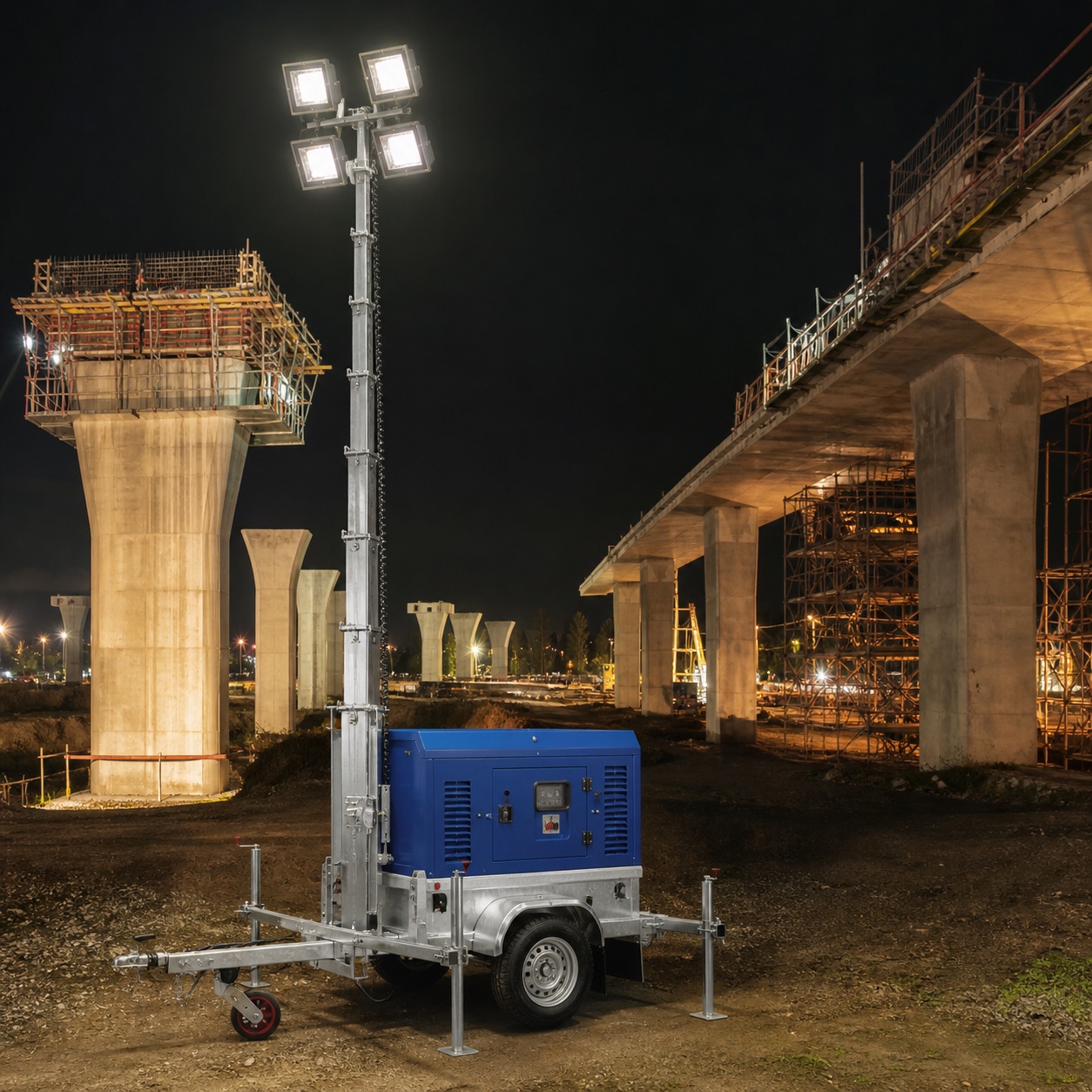
People usually ask this expecting a single number in square metres, and the number they get from a supplier is rarely the number they get on site. The reason is that coverage is not a property of the unit alone — it is a property of the unit, the mast height, and what is standing in the way.
One mast lights a work area, not a site
The useful way to think about it is per task, not per hectare. One mast lights a pour, a junction, a stretch of carriageway, a loading bay. It does not light a whole construction site, and a supplier who tells you it does is selling you a second callout.
If you are trying to cover a large area with one unit, what you actually get is a bright middle and dark edges — and the dark edges are where people trip.
Why height matters more than wattage
Raising the mast spreads the same light over more ground. Lowering it concentrates it. That is why an 8 m mast and a shorter one with identical lamps behave completely differently, and why the honest answer to "how bright is it" starts with "how high are you putting it".
It also means you have a control on site that costs nothing. If the pool of light is too tight, raise it. If the middle is not bright enough for detail work, bring it down.
Two units at opposite corners beat one at full output
This is the single most useful thing to know about site lighting. A large area lit by one very bright mast has hard shadows behind every obstruction — every stack of formwork, every excavator, every pile of spoil.
The same area lit by two masts at opposite corners has almost none, because what one unit shadows the other fills. Two moderate units genuinely beat one turned all the way up, and it is usually not much more to hire.
Glare is the failure people do not plan for
A mast pointed badly will blind a machine operator or an oncoming driver far more effectively than it lights the work. On roadworks this is a safety issue, not a comfort one.
Aim the heads down onto the work rather than out across it, and check what the site looks like from the driver's seat and from the road, not just from where the unit stands.
How to size it before you book
Walk the area and mark the tasks, not the boundary. Count how many separate places people will actually be working after dark. That count, not the site area, is the number that tells you how many masts you need.
If you send us a photo of the area with a rough idea of where the work happens, we will tell you honestly whether one unit does it — including when the answer is that it does not.
Obstructions matter more than distance
The number people want is a radius, but light does not travel in a radius on a real site. It travels until something stops it, and construction sites are full of things that stop it.
A single stack of formwork, a parked excavator or a spoil heap will put a hard shadow across a working area from thirty metres away. That shadow does not shrink because the lamp is brighter — it gets sharper.
This is why walking the site matters more than reading a specification. Stand where the crew will stand, look back at where the mast will be, and note what is in between. Anything solid on that line is where your dark patch will be, and moving the mast five metres is usually a better fix than hiring a bigger one.
Lighting for safety versus lighting for detail
These are two different requirements and they need different amounts of light. Moving safely around a site — seeing edges, drops, plant and other people — needs far less than setting formwork or reading a level.
Splitting the site along that line usually saves money. General movement areas, walkways and access routes need broad, even coverage at moderate output. The one or two places where precise work happens need concentrated light, and often a lower mast pointed at exactly that spot.
Trying to serve both requirements with one setting means either over-lighting the whole site or under-lighting the work. Ask for the split when you enquire and it usually resolves into fewer units, not more.
Ask about a light tower for your site
Send the site, the dates and roughly how many hours a night you need the lights on. You get a rate back.
Ask on WhatsAppLight tower questions people ask
Can one light tower cover a whole construction site?
Almost never. It lights a work area. For a full site you are looking at several units positioned around the tasks, or one unit moved as the work moves.
Does a higher mast mean brighter light?
The opposite, at any given point. Height spreads the same output over more ground, so the area gets bigger and the peak brightness drops. Height is a coverage control, not a brightness one.
How do I stop the lights blinding drivers?
Aim the heads down onto the work rather than outward, and check the view from the road before you leave. On a live carriageway this matters more than coverage.