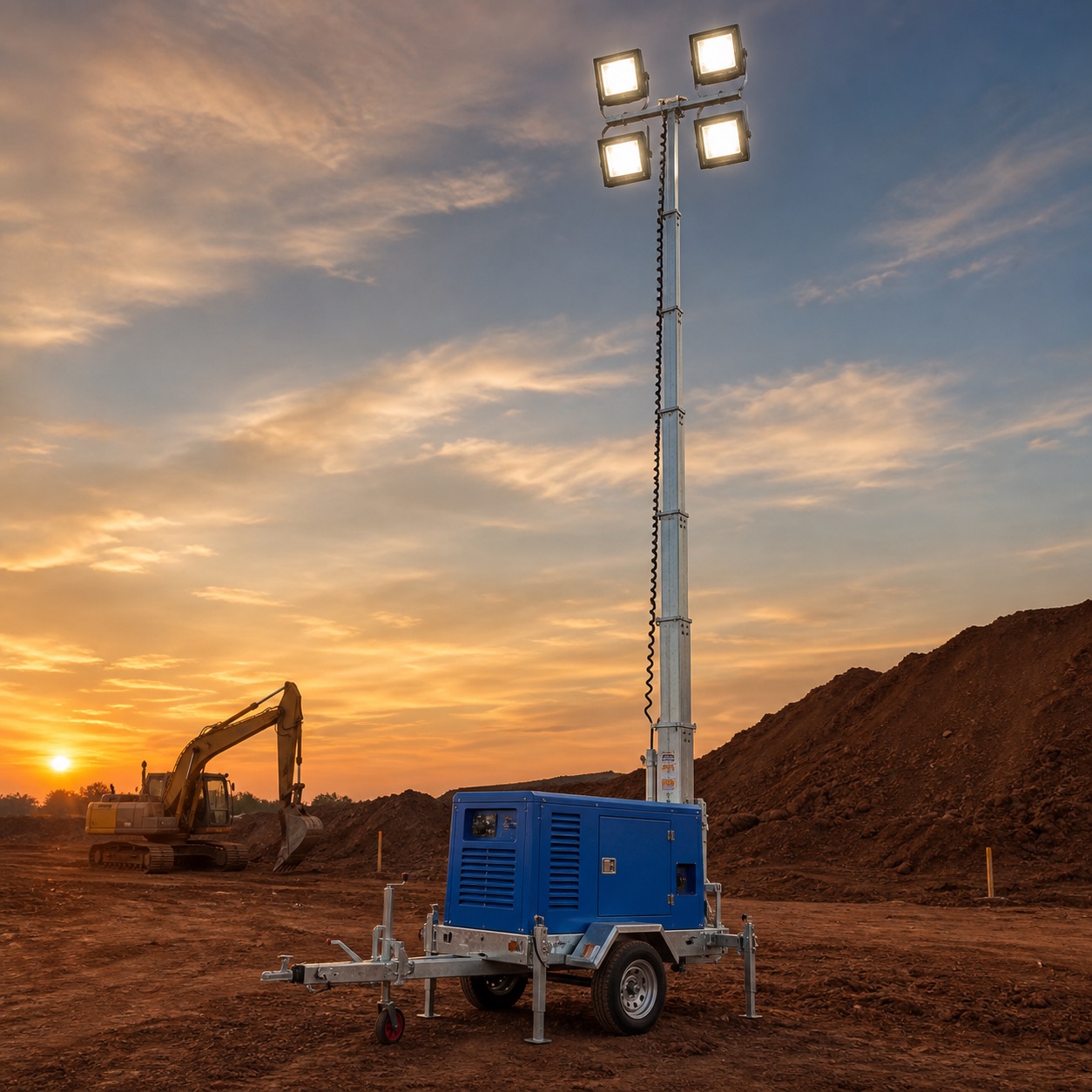
A construction light tower is simple equipment that fails in predictable ways, and almost all of those failures happen in the first hour rather than at 3am. This is what to get right before the crew turns up, so that the light is not the thing holding the shift back.
Position it before you need it, not after dark
Site the unit in daylight. Positioning a mast in the dark, on ground you cannot see, with a crew waiting, is how units end up somewhere convenient rather than somewhere useful.
Walk to where the work will actually happen and look back at where the mast will stand. If a stack of material is going to sit between the two by midnight, move it now.
Ground and stability come before everything
A raised mast is a lever. On soft ground, on fill, or on a slope, the outriggers matter more than anything else about the unit — and Malaysian sites after rain are exactly the conditions where this gets ignored.
Level it, extend the outriggers fully, and put boards under them on soft ground. If the mast is up and the base is not solid, lower it and fix the base rather than hoping.
Wind is the one that catches people out
A fully extended mast in a squall is the failure mode with the worst consequences, and Malaysian weather delivers squalls with very little warning.
If a storm is coming through, lower the mast. Light for an hour under a lowered mast is a nuisance; a mast down across the works is a different kind of night.
Plan around refuelling, do not discover it
Work out before the hire starts who fills it, when, and how they reach it. A unit parked inside a closed area, behind a locked gate, or in a live lane is a unit somebody has to plan a route to at 1am.
For longer hires we sort top-ups when you book, which removes the whole problem — but it only works if the access is discussed rather than assumed.
Check what the light does to everyone else
Before you sign off the position, look at the site from three places: where the crew works, where machines move, and where the public passes.
Light aimed across the work rather than down onto it blinds operators and drivers. If a machine operator is squinting, the lighting is making the site less safe, not more, no matter how bright it is.
Handover matters as much as setup
Most site lighting problems are handover problems. The person who positioned the unit finishes their shift, and the crew who arrive at dusk have no idea it can be raised, lowered, aimed or moved.
Show at least two people on the night crew how to lower the mast and where the fuel goes before you leave. That single conversation prevents the most common two failures: a mast left up through a storm, and a unit run dry because nobody knew it was their job.
It is also worth agreeing who calls us. A fault that everyone assumes somebody else has reported is a fault that runs for a week.
Lighting a site that moves
Linear works — a carriageway, a pipeline, a drainage run — are a different problem from a fixed site, because the work front moves every few days and the lighting has to move with it.
Plan the moves rather than reacting to them. If the front advances fifty metres a night, a unit positioned for Monday is behind the crew by Wednesday. Either agree a repositioning rhythm at the start, or take two units and leapfrog them so there is never a night with the mast in the wrong place.
Neighbours, and the complaint you can prevent
Night works near housing generate complaints about light as often as about noise, and light complaints escalate faster because they are visible from a bedroom window.
Two things prevent most of them. Aim the heads down and inward so the spill stops at your boundary rather than crossing it, and lower the mast when the works allow — a lower mast throws less light sideways.
If the works run for weeks, it is worth telling the nearest residents what the hours are before they have to work it out themselves. A complaint that becomes a council matter can shut down night working entirely, which costs far more than the twenty minutes of repositioning that would have avoided it.
Ask about a light tower for your site
Send the site, the dates and roughly how many hours a night you need the lights on. You get a rate back.
Ask on WhatsAppLight tower questions people ask
How close to the work should the mast stand?
Close enough to light the task, far enough that plant can move without clipping it. Then aim the heads down onto the work rather than across the site.
Should I lower the mast every night?
Not routinely, but lower it for storms and for high wind. That is the failure with the worst outcome and the easiest prevention.
Who is responsible if a unit breaks down mid-hire?
We are. Units are checked between hires, and a breakdown on your site is our callout rather than your delay.