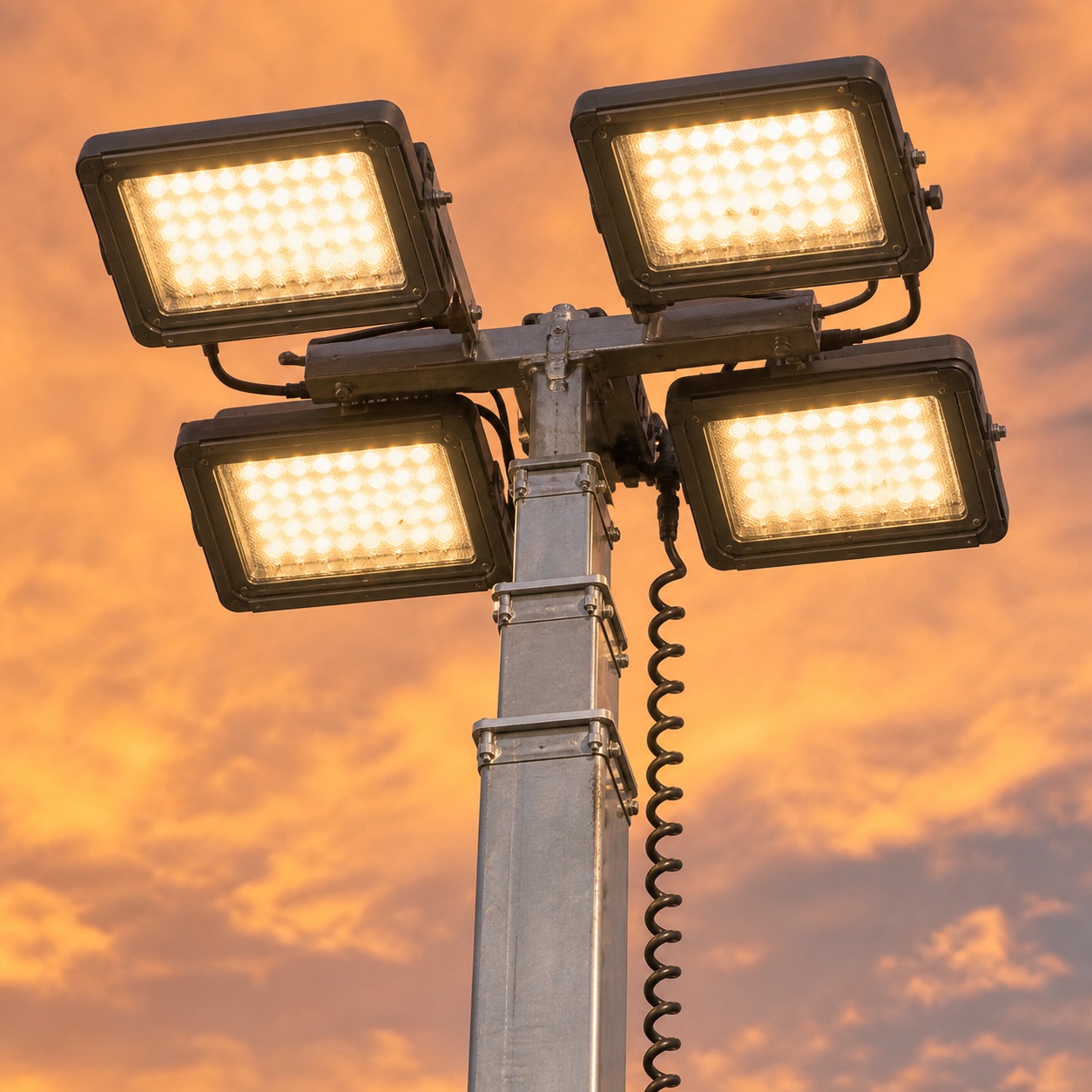
Light towers are simple machines that live outdoors in a climate designed to destroy machines. Knowing what fails is useful whether you own one or hire one — if you own it, it is your maintenance schedule; if you hire it, it is what you should expect a supplier to have already dealt with.
The winch and mast assembly
This is the part that strands a unit. Cables fray, winches seize, and mast sections bind if grit gets into them — which on an earthworks site it will.
A mast stuck up is worse than a mast stuck down, because now the unit cannot be towed or safely left through weather. This is why the mast is the first thing that should be inspected between hires, not the last.
Outriggers and the base
Bent, seized or missing outrigger feet are common on units that have been through several careless hires, and they are the difference between a stable mast and a lever waiting for wind.
Check them before you raise anything. If a foot will not extend fully or the pin is missing, that unit should not go up.
Lamps, drivers and wiring
LED heads themselves last a long time. What fails is the driver electronics behind them and the wiring runs into the mast, both of which live with vibration, heat and water.
The symptom is usually one head flickering or dropping out rather than a total failure, so it is easy to ignore for a week — and easy to report on day one instead.
Fuel systems and batteries
On diesel units, contaminated fuel and blocked filters cause more no-starts than engine faults do. On solar and battery units, it is the battery bank that ages, and it ages faster if it is regularly run flat.
Both are maintenance items with a predictable life. Neither should be a surprise on a properly serviced unit.
What this means when you hire rather than own
Every one of the above is our problem. Units are checked between hires, and if one fails on your site that is a callout we make, not a night you lose.
What we ask in return is that you tell us early. A flickering head reported on the first evening is a swap; the same fault reported in week three is three weeks of working under three lamps.
Water, dust and the Malaysian climate
Everything above fails faster here than it does in a dry climate, and it is worth knowing why so the checks make sense.
Sustained humidity works on connectors and earth points, producing intermittent faults that come and go with the weather — the hardest kind to diagnose and the easiest to dismiss as a one-off. Heavy rain drives water into places a light shower never reaches, and laterite dust behaves like a grinding paste in mast sections and winch mechanisms.
The practical upshot for a hirer is that intermittent faults are worth reporting even when the unit is working when you call. A head that dropped out twice on Tuesday and is fine on Wednesday is a connector on its way out, not a ghost.
What good maintenance looks like from the outside
You cannot inspect a service history on a delivery, but you can read the unit. Clean lenses, outriggers that extend without persuasion, a mast that runs smoothly through its full travel, and a battery that holds when the engine is off all suggest a unit that gets attention.
Rust streaks below the lamp heads, a winch that needs force, and mismatched or missing pins suggest one that does not.
Storing a unit between phases
On stop-start projects, units often sit unused for weeks between phases, and that idle time causes its own faults.
Diesel left standing degrades, batteries self-discharge and seals dry out. If a unit is going to sit for more than a couple of weeks, it is usually better to tell us and have it collected than to leave it parked in a corner of the site accumulating problems and hire charges.
If it does stay, run it for a short period every week or two. That single habit prevents most of the faults that appear when a unit is woken up after a long gap.
Ask about a light tower for your site
Send the site, the dates and roughly how many hours a night you need the lights on. You get a rate back.
Ask on WhatsAppLight tower questions people ask
What should I check when a unit is delivered?
Outriggers extend and pin properly, mast raises and lowers smoothly, all four heads light. Two minutes on delivery saves the whole hire.
What happens if a unit fails at 2am?
Message us. Breakdowns are our callout — units are checked between hires precisely so this is rare, but when it happens it is not your delay to absorb.
Am I charged for a fault that was not my fault?
No. Normal wear and component failure sit with us. Damage from misuse is a different conversation, which is why the delivery check matters for both sides.