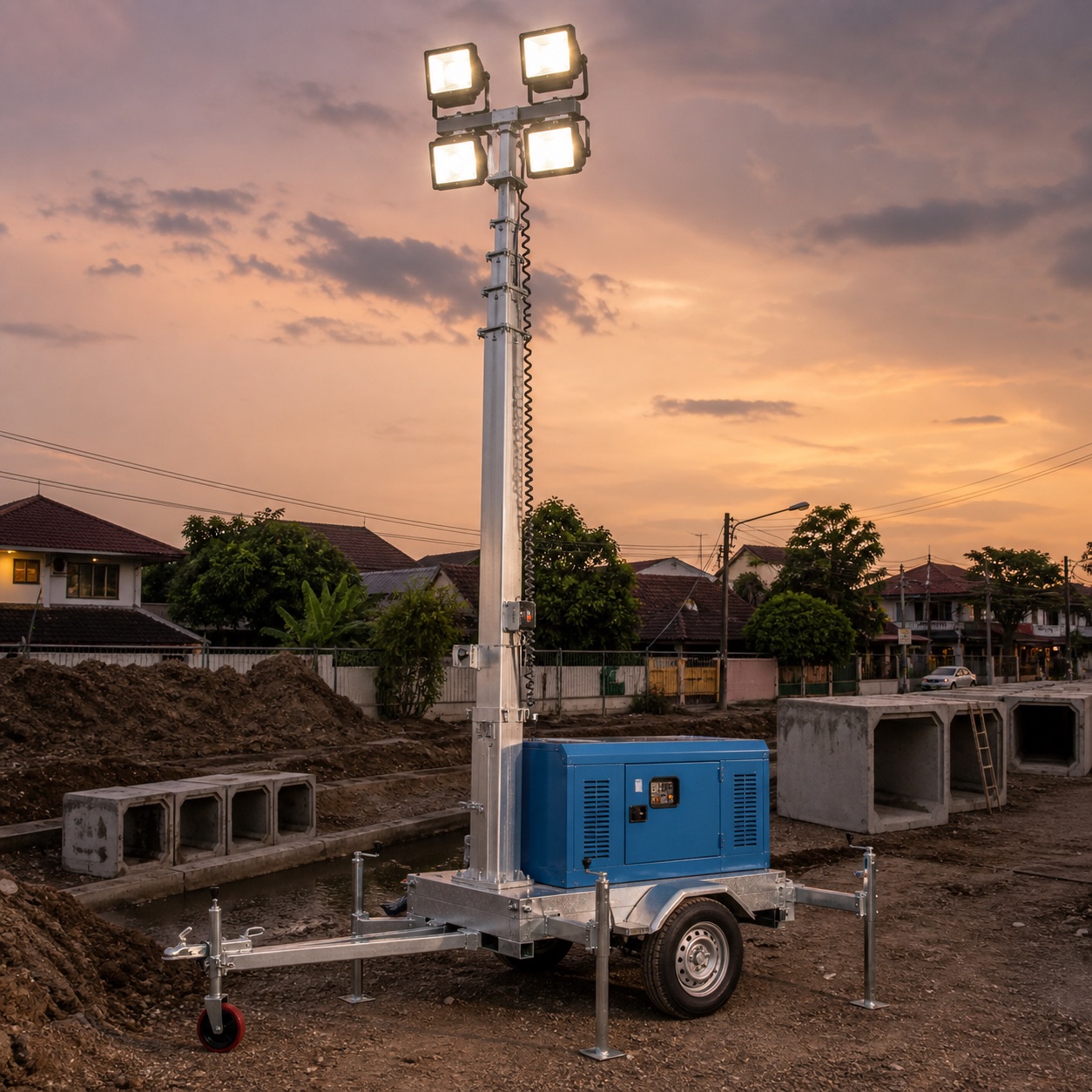
This is the most common question we get after price, and the honest answer is that neither one wins on merit — they fail in different places. A diesel unit fails you on noise and refuelling. A solar unit fails you on a week of rain. Which failure you can absorb is what decides it.
What a diesel generator light tower does well
It runs. That is the whole case, and it is a strong one. Fill it in the evening and it will hold four floodlights through the night without anyone thinking about it again, in any weather, at the end of any week of cloud.
For overnight construction — pours that cannot stop, piling, structural work running to a deadline — that predictability is worth more than the fuel it burns. If the light going out costs you a night of work, take the diesel.
Where diesel becomes the wrong answer
Two places. The first is noise. A silent diesel is quieter than a standard generator, but it is not silent, and a mast running metres from houses at 2am will generate complaints regardless of what the spec sheet says.
The second is refuelling access. If the unit sits behind a closed gate, inside a live carriageway, or somewhere a fuel run means a road closure, then the thing that makes diesel reliable becomes the thing that makes it a nuisance.
What a solar powered light tower does well
It charges by day and runs silent at night, with nobody driving out to top it up. On a residential site, a night market, or anywhere near people trying to sleep, that changes what is possible.
It also removes a whole category of small daily failure — the tank that nobody filled, the jerry can that leaked, the fuel that got used by something else. The unit either has charge or it does not, and you can see that before dark.
Where solar becomes the wrong answer
Consecutive overcast days. A solar unit banks what it collects, and a Malaysian monsoon week collects less than a dry one. Run-time on solar is a budget, not a tap.
Long dusk-to-dawn runs are the other one. If you need twelve hours of full output every night for a month, size that against the battery bank honestly before you commit — or accept that you may be running lower output for longer rather than full output all night.
A rule of thumb that holds up
If the site is loud already and the works are the reason people are awake, diesel. If the site is in among people who are trying to sleep, solar.
And if you genuinely cannot tell, send us a photo of the area and roughly what hours you need. The choice is usually obvious from the surroundings, and it costs nothing to ask before you book the wrong one.
What about running both
On sites that stretch across a boundary — works at one end, houses at the other — the answer is often one of each rather than a compromise. Diesel over the works where the noise is already part of the job, solar over the edge nearest the people.
This costs less than people assume, because the alternative is usually oversizing one unit to cover ground it was never going to reach. Two correctly placed units beat one working hard in the wrong position, and that holds for noise as much as it does for light.
If your site has that shape, say so when you enquire. It is a common pattern on drainage works, road widening and anything running through a residential stretch, and it is much easier to plan at booking than to fix in week two.
How to test the choice before you commit
If a job is going to run for months, it is worth treating the first week as a trial rather than a decision. Take whichever unit looks right, and note two things each night: whether anyone complained, and whether the light was still doing its job by the end of the shift.
Those two observations answer the question better than any specification comparison. Noise complaints tell you that you should have gone solar. Output fading before the crew finished tells you that you should have gone diesel.
Neither mistake is expensive if you catch it in week one and swap. Both are expensive if you discover them in month three and decide it is too late to change. Tell us at the booking stage that you may want to switch, and we will note it against the hire rather than treating it as a new enquiry.
Ask about a light tower for your site
Send the site, the dates and roughly how many hours a night you need the lights on. You get a rate back.
Ask on WhatsAppLight tower questions people ask
Is a solar light tower cheaper to run?
It has no fuel cost, which is the obvious saving. Whether it is cheaper overall depends on the hire rate and whether the run-time suits your hours — worth pricing both for the same dates.
How long does a solar unit last on one charge?
It depends on the battery bank, the output you run and how much sun the previous day gave it. Ask us for the figures on the specific unit before you plan around it.
Can I switch mid-hire if I picked wrong?
Message us. If the alternative unit is free we would rather swap it than have you working under the wrong one for three more weeks.