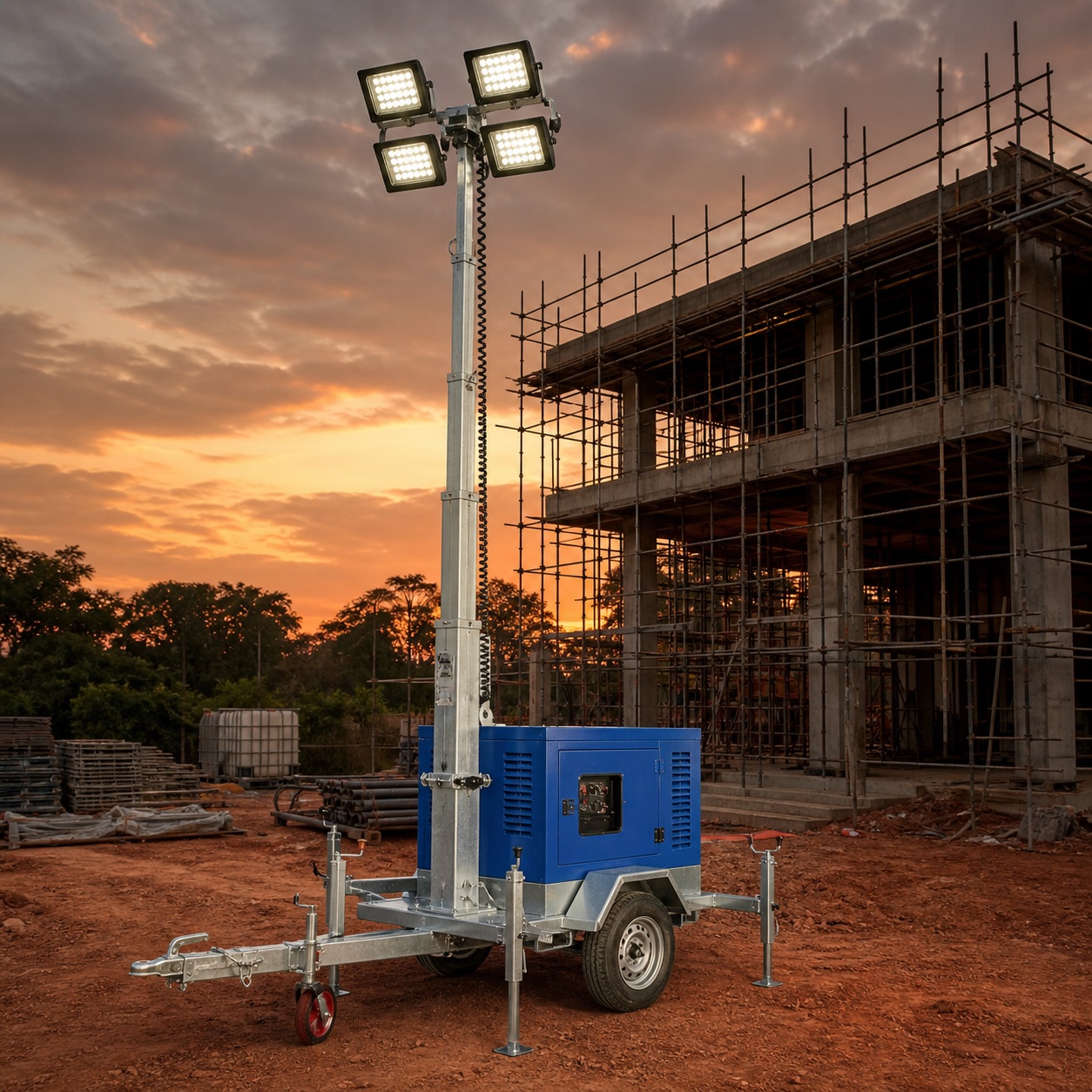
Metal halide ran site lighting for decades and is now mostly gone from new fleets. The reasons are not marketing — they are fuel burn and the restrike delay, and both of them show up as real cost and real lost time over a long hire.
Fuel per unit of light
This is the headline. LED heads produce more usable light per watt than metal halide, which means the generator behind them works less hard for the same brightness on the ground.
Over one evening that is a rounding error. Over a month of dusk-to-dawn running, with you paying for the diesel, it is not.
Restrike is the one people underestimate
A metal halide lamp that loses power does not come straight back. It needs to cool before it will restrike, and that is minutes of darkness after every interruption.
LED comes back instantly. On a site where the generator occasionally stumbles, or where somebody knocks a switch, that difference is the gap between a flicker and a stopped crew.
Light quality and glare
LED heads are directional by nature, which is good for putting light where you want it and bad if they are aimed carelessly — a badly aimed LED head is a harsher glare source than the halide it replaced.
The fix is aiming rather than dimming: heads down onto the work, not out across it. Done properly the colour rendering is better, which genuinely helps for detail and for reading marks.
Where metal halide still shows up
Older fleets, mostly. There is a lot of serviceable halide equipment still in circulation, and for occasional short hires it works perfectly well.
If you are offered one for a long overnight hire, it is worth asking what the fuel difference looks like across the full term before deciding on rate alone.
What our units run
Our 8 m diesel unit carries four 500 W LED heads in a 2 by 2 cluster on the mast. That is the configuration behind the RM3,500 monthly rate.
If you have a reason to want something different — a specific colour temperature, a specific throw — tell us what the job needs rather than the part number, and we will say what fits.
Colour temperature and why it matters at 3am
Beyond output there is the quality of the light, and it affects how tired people get. Very cold white light reads as bright and alert early in a shift and becomes harsh over a long night, particularly in rain, where it scatters and produces a glare haze.
Slightly warmer output cuts through wet air better and is easier to work under for twelve hours. If your crews are running full nights rather than a few hours past dusk, that is worth asking about rather than defaulting to whatever is coldest.
It also affects what people can see. Colour rendering matters when the work involves reading marks, matching cable colours or spotting a hairline crack — tasks where a technically bright light with poor rendering makes people slower rather than faster.
Replacing halide on a long hire
If you have an existing hire running on metal halide and the job has extended, it is worth asking whether an LED unit is available for the remainder.
The swap costs a delivery, but on a multi-month overnight hire the fuel difference and the removal of restrike delays usually pay for that quickly. It is a question worth putting rather than assuming the unit you started with is the unit you finish with.
Dimming and staged output
Not every hour of a night shift needs full output, and units that allow staged or partial output let you match the light to the work rather than running everything flat out until dawn.
The saving is real on fuel, and the wear saving on the generator is real too. It also reduces spill at the times when it is most likely to bother somebody — the small hours, when everything around the site is dark and quiet.
Ask what the unit allows before you plan around it. Some configurations switch heads individually, some step the whole array, and some do neither.
Ask about a light tower for your site
Send the site, the dates and roughly how many hours a night you need the lights on. You get a rate back.
Ask on WhatsAppLight tower questions people ask
Are LED tower lights brighter than metal halide?
Not automatically — it depends on the units. What LED reliably gives you is more light per watt of fuel burnt, plus instant restrike.
Does LED reduce my fuel bill much?
Over a single evening, barely. Over a month of long nights it is a real number, which is why it matters most on exactly the hires people compare on rate alone.
What wattage are the heads on your units?
The 8 m diesel unit runs four 500 W LED heads in a 2 by 2 cluster.
Can I mix LED and halide units on one site?
You can, but the colour difference between them is noticeable and it makes the site look patchy. If you are lighting one continuous area, keep the lamp type consistent and use the mixed units on separate zones.